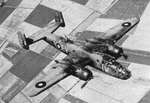
North American Mitchell II
of No.180 Squadron
|
|
Aircraft - Locations - Group and Duty - Books
No.180 Squadron was formed around the North American B-25 Mitchell in 1942 and operated that aircraft over Northern Europe until the end of the Second World War.
The squadron was formed at West Raynham on 13 September 1942, as part of No.2 Group, Bomber Command. It received its first Mitchells in the same month, just after No.98 Squadron became the first in the group to use the new bomber on operations. The squadron and received 22 aircraft by the start of November.
No.180 Squadron flew its first combat mission on 22 January 1943, a costly attack on Ghent that saw two aircraft lost. A pause followed, before operations resumed in May. At the end of May 1943 No.2 Group, and No.180 Squadron with it, left Bomber Command to join the Second Tactical Air Force. Nos.98, 180 and 320 Squadrons formed No.139 Wing (originally designated as No.138 Airfield), all equipped with the Mitchell. The wing flew daylight raids on tactical targets in France and Belgium, in preparation for the D-Day landings. This also saw the squadron go on a two week bombing course at Swanton Morely in April 1944, before in the following month switching to night bombing for the D-Day period.
From May until October the squadron operated at night against German troops, transport links and other tactical targets, supporting the fighting in Normandy and Northern Europe. It also took part in a set piece attack on the HQ of Panzer Group West at the Chateau of La Caine on 10 June 1944, providing part of the force of 61 Mitchell bombers that took part in the attack. By September the advancing armies had moved too far east for No.180 Squadron to easily support them, and attention turned to those isolated pockets of German resistance left on the French coast.
In October the group moved to Europe, and resumed operations in support of the main armies. It took part in the fighting during the battle of the Bulge, attempting to attack a German troop concentration at Henebach on 22 December, despite thick cloud cover that made it impossible to judge the success of the raid.
On 1 January 1945 the squadron was in the air during Operation Bodenplatte, a massive attack on Allied airfields that was the Luftwaffe's last gasp, although three aircraft were destroyed on the ground. From then until the end of the war the squadron operated ever further to the east, moving to a base in German in April 1945. Communication links were its most important target during this period, and the near-total disruption of every road and rail link in German played an important part in the eventual German collapse.
At the end of the war the squadron remained on the continent, exchanging its lend-lease Mitchells for Mosquitoes in September 1945. In March the squadron moved to Wahn, to become part of the post-war occupation force, and on 31 March 1946 it was renumbered as No.69 Squadron.
Aircraft
September 1942-September 1945: North American Mitchell II
October 1944-September 1945: North American Mitchell III
September 1945-May 1946: de Havilland Mosquito XVI
Location
September-October 1942: West Raynham
October 1942-August 1943: Foulsham
August 1943-April 1944: Dunsfold
April 1944: Swanton Morley
April-October 1944: Dunsfold
October 1944-April 1945: B.58 Melsbroek
April-June 1945: B.110 Achmer
June 1945: Fersfield
June-September 1945: B.110 Achmer
September 1945-March 1946: B.58 Melsbroke
March 1946: Wahn
Squadron Codes: EV
Duty
September 1942-Summer 1943: Medium Bomber Squadron, Bomber Command
Summer 1943 onwards: Medium Bomber Squadron, Second Tactical Air Force
Part of
From 13 September 1942: No.2 Group
4 March 1942: No.2 Group; Bomber Command
From June 1943: No.139 Airfield (later Wing), Second Tactical Air Force
6 June 1944: No.139 Wing; No.2 Group; Second Tactical Air Force; Allied Expeditionary Air Force
 Bomber Offensive, Sir Arthur Harris.
The autobiography of Bomber Harris, giving his view of the strategic bombing campaign in its immediate aftermath. Invaluable for the insights it provides into Harris’s approach to the war, what he was trying to achieve and the problems he faced. Harris perhaps overstates his case, not entirely surprisingly given how soon after the end of the war this book was written (Read Full Review)
Bomber Offensive, Sir Arthur Harris.
The autobiography of Bomber Harris, giving his view of the strategic bombing campaign in its immediate aftermath. Invaluable for the insights it provides into Harris’s approach to the war, what he was trying to achieve and the problems he faced. Harris perhaps overstates his case, not entirely surprisingly given how soon after the end of the war this book was written (Read Full Review)






Bookmark this page:
 Delicious
 Facebook
 StumbleUpon